sábado, 12 de septiembre de 2009

Jean Rouch

"No se trata de hacer grandes propósitos, sino de tener el coraje de realizar las historias que cada uno quiere hacer y hacerlas a través de métodos de resistencia."
-Jean Rouch


Jean Rouch, con alrededor de 120 títulos, descubrió su pasión por el cine en los films de Robert Flaherty y Dziga Vertov, que le enseñaron a utilizar la cámara como instrumento para descubrir el mundo.
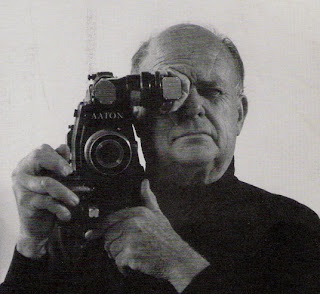

“…El cine ya es en sí el arte de dos cosas al mismo tiempo, el movimiento entre el mundo real y el mundo de la imaginación; es en este punto donde se encuentra la etnografía la cual estudia los sistemas de otros, en un continuo ir y venir entre mundos conceptuales."
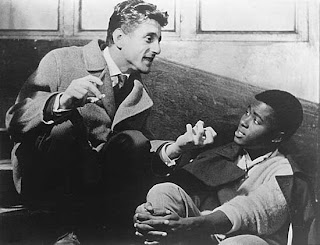
- Jean Rouch


Jean Rouch nació el 31 de mayo de 1917 en Paris. Creció mudándose entre Europa y Africa. Su padre era un oficial de la marina que había sido explorador en un barco llamado "Pourquois Pas?". Su madre venía de una familia de poetas y pintores. Estudió Ingeniería, descubrió la Cinemateca Francesa, el surrealismo, el Musée de l"Homme y el Jazz.

Después de la segunda guerra mundial se mudó junto con dos amigos a l oeste de África para trabajar como ingenieros civiles. En 1941 se muda a Nigeria. Ahí conoció a Damouré Zika quien lo introdujó en el mundo de la religión Songhay.
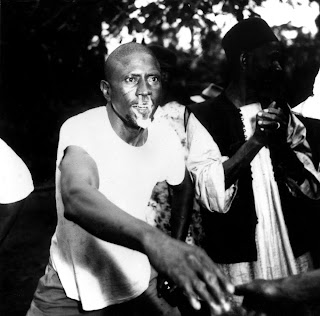
"living, with our body, the adventure of another..."
-Jean Rouch

Rouch empezó a mostrar sus films en África e incorporó comentarios de los sujetos filmados en su trabajo, creando así lo que él llamó "shared antropology", concepto fuertemente inspirado en el trabajo de Flaherty y que se volvería central en el resto de sus obras.

En los siguientes años, Rouch realizó una serie de films que él calificó como "ethno-fiction", en la que se combina la etnografía con la puesta en escena de la realidad. (Jaguar y Petit à Petit. J

Jean Rouch murió en un accidente de coche en Nigeria el 18 de febrero del 2004 a sus 86 años. Iba camino a una celebración de cine Nigeriano, que tenía planeado mostrar una retrospectiva de su trabajo.


Moi, un Noir: "the best French film since the liberation."
-Jean Luc Godard

Cinéma Vérité:

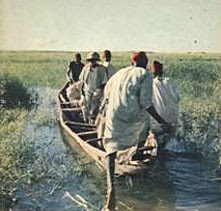
"In 1946, three friends from Ponts et Chaussées, the engineering school in Paris, descended the Niger River in a dugout canoe. Under the name Jean Pierjean, a combination of each of their names, they sent photos and articles back to Paris to pay their way, and made 16mm films of a hippopotamus hunt that some of their African friends were engaged in. When one of the three — Jean Rouch — lost his tripod in some rapids, they were forced to continue filming with a handheld camera. And thus the early history of cinéma-vérité, a term Rouch would later coin, began to unfold."

"In the summer of 1960, Rouch and sociologist Edgar Morin shot Chronique d'Un Eté (Chronicle of a Summer), in Paris. In Chronique, the formerly invisible barrier between the "objective" filmmaker and his subject dissolved. The filmmaker is seen approaching his subjects, inquiring, "Are you happy? How do you live?" Technically, Chronique furthered the development of a more portable, synchronous sound system that permitted the filming of longer, unbroken sequences — a breakthrough that continues to have profound influence on documentary filmmaking today. Morin and Rouch termed this new style of filmmaking "cinéma-vérité," a translation of Vertov's kino-pravda or film-truth."
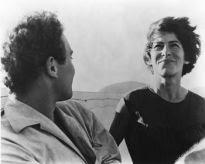


Les Maitres Fous:

"In 1955 Rouch presented what is now one of his best-known films, Les Maîtres Fous, at the Musée de l'Homme. The film, which depicts a ceremony of the Hauka possession cult, is filled with disturbing images. Reaction to the film was strong: it was banned in Britain and the Gold Coast, but received the Grand Prix at the Venice Biennale."

Los Maestros Locos. Imposible no quedar impactado. Imagenes obscenas, grotéscas y sin embargo algo no permite voltear la mirada. Controversial y polémica, este documental nos reta continuamente a desafiar nuestros prejuicios, a confrontar la naturaleza humana, a cuestionar nuestros propios rituales.

La mirada de Rouch es calida, no enjuiciadora. Es como la mirada del niño que mira por primera vez a su padre rasurarse y se fascina tan sólo de mirarlo y que sin dejar de intentar entender y aprender, logra verse reflejado en potencia y no puede esconder su asombro y su fascinación. Jean Rouch, un africano más, nos muestra los rituales de sus hermanos de Nigeria.

La forma, la espontaneidad de la estética nos obliga a creer en lo fidedigno de la puesta en situación. La voz en off de Rouch nos convierte en su confidente, en aquel al que se le cuenta hasta el último detalle de la experiencia vivida y empapada ya de su propia interpretación. Uno, como espectador-confidente entiende la relevancia de cumplir bien el papel que Rouch nos designa. Así, por más que uno quisiera, no puede defraudar a este gran director y decidir renunciar a la experiencia que ofrece. Romper el lazo de complicidad que genera en su cine conllevaría a sentir que se ha fallado, que uno no ha estado a la altura del reto que Rouch presentaba, que el desafío ha sido en vano.


VIDEOS
:

First half of Jean Rouch's comments about his documentary "Bataille sur le grand fleuve" ("Hippopotamus hunt"). He stresses how and why the editor and the director should be two... Second half of Jean Rouch commenting his "Bataille sur le grand fleuve". An anecdote illustrating the importance of informant feedback, and ethnocentered temptations while making an ethnographical documentary.


A film by Philo Bregstein, in cooperation with Dutch Television, distributed by Documentary Educational Resources
Jean Rouch and His Camera in the Heart of Africa provides an in-depth look at the film work of Jean Rouch and his associates from Niger who participated in the production of many of Rouch's Niger-based films. Most of the camera and technical work was accomplished by Niger filmmakers. Bregstein, Rouch, Damoure, Lam, their friend Tollou and others converse about filmmaking and filmmakers who have had historical influence in the field; segments from several of Rouch's earlier film works are interspersed with the filming in Niger and with interviews. Some of the films from which clips are included and discussed by Rouch and Bregstein are Chronicle of a Summer, Moi, un Noir, Tourou et Bitti, Battle on the Great River, Jaguar, Les Maitres Fous, The Lion Hunters, and Petit a Petit.


Rouch filmed this loving and humorous portrait of anthropologist and filmmaker Margaret Mead in September 1977 while he was a guest of the first Margaret Mead Film Festival. As both a friend and colleague, Rouch reveals a glimpse of the legendary Mead in her later years. (Fellow filmmaker John Marshall was the sound recordist.)


Jean Rouch appeared on Screening Room in July 1980 and screened Les Maitres Fous as well as several film excerpts including Rhythm of Work and Death of a Priest. Over a period of five decades Jean Rouch made many films about the Songhay and Dogon of West Africa. He also made, with Edgar Morin, the classic documentary, Chronicle of a Summer about the lives of Parisians. Rouch frequently traveled with his films, showing and talking about them to a wide audience. Regarded as one of the fathers of "Direct Cinema" and considered one of the most influential documentary makers of the twentieth century, his films are very difficult to find, particularly in North America.


Rouch on the future of Visual Anthropology interviewed In the summer of 2001 when the IWF in Göttingen hosted the conference "Orig Rouch on the future of Visual Anthropology interviewed In the summer of 2001 when the IWF in Göttingen hosted the conference "Origins of Visual Anthropology - Putting the Past Together".

*Algunas de las bandas sonoras se encuentran en:

http://www.maitres-fous.net/Music.html

sin embargo me fue imposible postearlas directamente en el blog.


FUENTES:
  • Cine Encuentro. 4ta Muestra DIP. Jean Rouche. http://www.cinencuentro.com/4-muestra-dip/jean-rouch/
  • YouTube. Jean Rouch on the Visual of Anthropology. http://www.youtube.com/watch?v=ZFNgL_Wrsp8&feature=related
  • YouTube. Screening Room with Jean Rouch. (PREVIEW). http://www.youtube.com/watch?v=kQ6sTAY4QCM&feature=related
  • YouTube. Jean Rouch on Editing. http://www.youtube.com/watch?v=OqCPwmB7k3A&feature=related
  • YouTube. Jean Rouch on Feedback and Documentary Music. http://www.youtube.com/watch?v=VSs1S5ET1xU
  • YouTube. Margaret Mead: Portrait by a Friend. PREVIEW http://www.youtube.com/watch?v=xzohD3mKpNg
  • YouTube. Jean Rouch and his Camera in the Heart of Africa. PREVIEW. http://www.youtube.com/watch?v=3jzAegaqqf4&feature=related
  • Jean Rouch: A Tribute. http://www.der.org/jean-rouch/content/index.php?id=about_biography
  • Cine Club Magdalenes. http://cineclubmagdalenes.blogspot.com/2009/03/jueves-5-moi-un-noir-jean-rouch-1958.html
  • Maitres-Fous. http://www.maitres-fous.net/Music.html

Nanook of the North

Nanook of the North
A Story of life and love in the Arctic
produced by Robert J. Flaherty


The sterility of the soil and the rigor of the climate
no other race could survive;
yet here, utterly dependent upon animal life,
which is their sole source of food,
live the most cheerful people in all the world
- the fearless loveable happy-go-lucky Eskimo.


Chief of the 'Itimuits'
and as a great hunter famous through all Ungava
- Nanook, The Bear.

http://www.bnl.lu/new/nos_select/media/images/nanook.jpg

Nanook. Primer documental en forma. Controversial debido a la manipulación evidente generada a través de los intertítulos que cesgan al espectador antes de comenzar a ver el film. También por la recreación de escenas, como el despertar en el iglú, y la intervención por parte de Flaherty en la vida cotidiana de los Esquimales (cuando les solicita cazar a la morsa con un harpón, en lugar de con escopetas, o cuando les pide que muestren asombro ante el gramófono, cuando evidentemente eran esquimales bastante occidentalizados.)


La polémica: ¿qué es un documental? ¿Nanook es un documental a pesar de la ficción que reside en ella? No hay una respuesta clara, pero como menciona José Manuel López en la edición Española de Cahiers du Cinéma, "El cine debe perder de una vez los apellidos". La línea entre documental y ficción no está del todo definida y no hace falta definirla. Al final, ficción o documental, sigue siendo cine, que desde su mecanismo es pura ilusión de movimiento. El cine son signos y la interpretación de los mismos reside en cada uno de nosotros. Como lo explica Bazin en ¿Qué es el Cine?: las imágenes en la película son como las piedras que atraviesan un río, están ahí sin ningún sentido previo a nosotros, después llegamos nosotros y les damos sentido utilizándolas para cruzar al otro lado del río, y en ese momento se crea el cine.


La cámara en Nanook es parte de la vida diaria de los Esquimales, no se siente ajena, al contrario, se siente confiada y cómoda. La relación entre ella y los Esquimales es parecida a la de una familia, comparten risas, miedos y uno que otro enfrentamiento.

Un gran documental que ha sobrevivido al paso del tiempo, que sigue generando asombro, que marcó una bifurcación en el destino del cine y que abrió todo un nuevo espectro de posibilidades para los amantes del cinematógrafo.


Robert Joseph Flaherty. El padre del documental.


« Nowhere has man learned to do so much with so little ».
Robert J. Flaherty


Bazin y El Documental de Exploración.


"Estas primeras obras maestras del largometraje documental encierran con frecuencia las mejores cualidades del género: una autenticidad poética que no ha envejecido. (...) Aunque lo sensacional no quede abolido por principio, queda al menos subordinado a la intención documental de la empresa. Y esto tiene como consecuencia el reducirlo casi a la nada, ya que es realmente raro - como veremos - que la cámara pueda ser testigo de los momentos más peligrosos de la expedición. En revancha, el elemento psicológico y humano pasa a primer plano, tanto en relación con los mismos autores, cuyo comportamiento y reacciones ante la tarea a realizar constituyen una especie de etnografía del explorador, una psicología experimental de la aventura, como en relación con los pueblos visitados y estudiados que no se consideran ya como una variedad de animales exóticos y a los que se procura describir mejor para poder comprenderlos" (Bazin, p.42-44)


Flahery y Murnau en Tabú.

Después de ver Nanook of the North, uno no puede evitar crear una relación con otro documental etnográfico de la época: Tabú de Murnau. Curiosamente al empezar a buscar información sobre el film, note que había más que una relación generada en mi cabeza, ya que resultó ser que Flahery y Murnau habían comenzado juntos el proyecto.


"A finales de los años veintes, Murnau harto de las interferencias y manipulaciones, coge el dinero ganado en Hollywood y se asocia con Robert Flaherty, creador del formato largometraje documental y director de obras del nivel artístico e importancia histórica de "Nanuk, el esquimal" o "Los hombres de Aran". Viajan hasta los lejanos mares del sur, muy lejos de Hollywood, para realizar un documental en total independencia. Una vez comienza el rodaje empieza ha haber problemas entre los co-director, Flaherty, más cercano a la escuela naturalista y documentalista, quiere coger la realidad intentando alterarla lo mínimo posible. Murnau, un esteta del romanticismo, busca la máxima expresión de la belleza y considera que el realismo debe supeditarse a esa búsqueda de la belleza. Las numerosas manipulaciones de la realidad que práctica Murnau desespera a Flaherty, que se enfada y se desvincula del proyecto, lo que facilita que Murnau haga lo que desee sin pedir cuentas a nadie."


"El resultado fue "TABU", un pseudo-documental mudo decididamente romántico, donde se confronta lo salvaje con lo civilizado, lo mágico con lo racional y el amor con la tragedia. Un argumento que se desarrolla y avanza con ritmo perfecto, y la aplicación del lenguaje cinematográfico en toda su capacidad (movimientos de cámara, aplicación de las luces y las sombras a nivel dramático,... ) hacen comprender el enfado de Flaherty, ya que lo que vemos más que un documental es una película con actores no profesionales. Si bien no es la mejor película de Murnau, su poesía, su frescura y su gran calidad artística la sitúan muy por encima de la mayoría de películas estrenadas, por lo general considerada una de los mejores documentales de la historia y dotada de una extraña sensibilidad que aún hoy se hace notar."


"Antes del estreno mundial de "Tabú" Murnau murió en un accidente de trafico, la leyenda superaba la realidad, se cuenta que rodó en territorios tabúes y que fue maldecido por los brujos indígenas. Otras opiniones no fueron tan románticas, Murnau era un homosexual declarado que nunca hizo ningún esfuerzo por disimular, en aquella época la homosexualidad estaba penada con cárcel y salir del armario no estaba tan bien visto como hoy, eso le dio mala fama entre los más conservadores de Hollywood. Según cuentan volvió de "los lejanos mares del sur" con un joven amante indígena, aún menor de edad, parece ser que estaba conduciendo el coche en el momento del accidente. Se llegó a especular que se estuviera realizando una felación en aquel momento."


Un documentalista explorador contemporaneo a Flaherty, pero Inglés.

H. G. Ponting


"El eterno silencio [L’ Eternel Silence], reportaje de H.G. Ponting sobre la expedición de Scott al Polo Sur (presentado en 1922), reveló el trágico destino de ese hombre que fracasó, habiendo debido pagar con su vida. Cuando Scott, al cabo de múltiples aventuras, alcanzó el polo, halló plantada la bandera Noruega de su competidor Amundsen. Este film (que no mostraba el fin trágico de Scott y la inutilidad absoluta de su ridículo sacrificio) sirvió durante la guerra de 1914-1918 con fines propagandísticos, elevando –al parecer– la moral de las tropas inglesas."


Arriba la mano congelada de H. G. Ponting durante la expedición de Scott.


"Herbert Ponting was the photographic officer on Captain Scott's last South Pole expedition, 1910-1913. He wrote of his experiences in The Great White South; or, with Scott in the Antarctic (1921) and in 1914 received a royal command to present a film lecture on his experiences at Buckingham Palace. More than a thousand other lectures followed, including one at the Philharmonic Hall in 1915."


His footage was first released in 1911 and again in 1912 as With Captain Scott, RN, to the South Pole; it was also released in 1924 in feature-length form as The Great White Silence; and it was re-edited in 1933 as 90° South and again, in 1936, as The Story of Captain Scott.


No encontré la película en internet,
sin embargo arriba está lo que parecen ser fragmentos del documental.

FUENTES:
  • ¿Qué es el Cine? A.Bazin. El Cine y la Exploración. Ediciones Rialp. España, 2006.
  • Grupo Paris. Ado Kyrou. El Surrealismo en el Cine: Los Otros Lugares. http://www.archivosurrealista.com.ar/Paris22c.html
  • Screen online. Hebert Ponting. http://www.screenonline.org.uk/people/id/874157/index.html
  • Royal Geographic Society. Herbert Ponting. http://images.rgs.org/search_.aspx?keyword=!ARTIST7361&displayNumPage=8&image_type_list=0&collection_list=-1&date_range_list=0&searchModeRefine=1
  • Actual Cine. Murnau. http://www.actualcine.com/weboscar/articulos/murnau.html

sábado, 29 de agosto de 2009

Harun Farocki

http://www.mycontemporary.com/resources/artist/harun_farocki/x-large/harun_farocki_n.jpg

Harun Farocki, cine-ensayista alemán. El más conocido de los desconocidos cineastas alemanes. Estudió cine en la Academia Alemana de Berlin de Cine y Televisión. A finales de los 60's comenczó a realizar sus primeros documentales, todos ellos con un contenido altamente político y con el propósito de agitar en contra de la guerra de Vietnam.

Su primer documental fuera de la escuela de cine, Fuego Inextinguible, es realmente extraordinario, sobre todo por la fuerza que tiene a pesar de casi no manejar escenas verdaderas, sino prácticamente puro re-enactment. Farocki no muestra escenas demasiado violentas, más bien se limita a aludirlas de manera poética e ingeniosa.

"Much beautiful cinema has been born of the circumstance that someone was not allowed to show something and therefore replaced an illustration with an illusion, using omission as a means for creating space for imagination."

-Harun Farocki


A finales de la década de los 70's Harun Farocki cambia su enfoque y comienza a realizar ficciones didácticas Marxistas y para las décadas de los 80's y 90's se vuelve mucho más versatil, concentrándose en los cine-ensayos y cine-documentales.

Far ockis work always begins with a crucial question: What is an image? he asks. What is representation, and how does it relate to that which is represented? By using images to comment on other images, a method he calls "horizontal montage", Farocki attempts to analyze that which can be found behind their visible surface. One of his long-term projects is concerned with the creation of a collection of filmic "expressions" that could be compared to a dictionary for spoken and written language. In a broad sense, this would include further systems of classification, the organization of image collections by topic and motive or even by their narrative meaning.

-Constanze Ruhm

http://www.bafici.gov.ar/home09/photobase/directors/harun_farocki_1.jpg

"What I want to get at is that there is almost no such thing as an active vocabulary of images, as compared to the vocabulary of language - and no possibility for linking expressions."

-Harun Farocki


http://www.donaldweber.com/wp/wp-content/uploads/2006/11/harun-farocki.jpg

El cine de Farocki es denso y complejo, cuesta trabajo de ver, sobre todo sus últimos trabajos. A mí en lo personal me gustaron más los que realizó en la decada de los setentas debido a que les encontré un tono sarcástico que los más recientes carecían. Sin embargo, me gusta que Farocki haya evolucionado con los años, que no se haya quedado estancado en su manera de contar las cosas ni en los temas que aborda. Hasta donde investigué hoy en día está más concentrado en realizar videoartes para exponerlos en museos que en la realización de documentales como tal.


Arriba Farocki habla sobre su manera de abordar un proyecto. Entrevista realizada en Barcelona con motivo del tercer premio del cine-ensayo.

FUENTES:

  • Cineteca Nacional. Ciclo Harun Farocki. http://www.cinetecanacional.net/ciclos.php?cic=1067
  • Haussite.net NICHT löschbares Feuer. http://www.haussite.net/set.php?page=http://www.haussite.net/haus.0/PROGRAM/INFO_2001/farocki/farocki_E.html
  • Rouge. Harun Farocki's Images of the World. http://www.rouge.com.au/12/farocki.html

lunes, 24 de agosto de 2009

Johan Grimonprez

Johan Grimonprez nació en Roeselare (Bélgica) en 1962. Estudió en la escuela de Artes Visuales en Nueva York y también asistió al programa independiente de estudios en el Whitney Museum.


Realizó Dial History en 1998. Documental que invita a la reflexión a través de su aparente banalidad. Baudrillard dijo hace un par de decadas que la manera de ejercer el control sobre la sociedad había cambiado: Ya no es a partir de la censura de la información. Ahora, por el contrario, es a partir del exceso de información. Parece complicado entender este nuevo medio de control, sin embargo Johan Grimonprez lo demuestra visualmente en Dial History. Este punto en el que hay tanta información, tantas imágenes, que uno no es capaz de distinguir cual vale más, cual es real, cual es ficción... Uno termina confundido y no siendo capaz de depurar la información que no vale la pena conservar.

El terrorismo es el tema central del documental, en específico el secuestro de aviones. Hasta cierto punto pareciera que Grimonprez se hubiera adelantado unos años a lo que sucedería el 11 de Septiembre del 2001. El ritmo tan cambiante, haciendo alusión a aquel de la televisión, vuelve al documental todavía un poco más violento.

Todo el largometraje está hecho a base de material apropiado: comerciales, noticieros, cámaras de seguridad, etc. Volviendo a Agnès Varda, este sería otro tipo de pepenaje, una manera de darle una segunda oportunidad al material filmado, de poder ser algo más, de no morir en el olvido. Es hermoso y poético el trabajo que realiza Grimonprez al rescatarlo y encontrar la profundidad dentro de lo, por origen, banal.


Arriba un fragmento de "Looking for Alfred" corto realizado en el 2005


Arriba un fragmento de "Double Take" largometraje realizado en el 2009


En los últimos años se ha volcado sobre Hitchock, obsesiónandose con su imagen, lo demuestran sus dos últimos trabajos cinematográficos citados arriba.


FUENTES:
  • You Tube. Johan Grimonprez, Looking for ALfred, 2005. http://www.youtube.com/watch?v=--X-5Rw2_vM
  • You Tube. Double Take - If You Meet Your Double You Should Kill Him. http://www.youtube.com/watch?v=pCKyyb_3VX0&feature=related
  • Sean Kelly Gallery. Johan Grimonprez. http://www.skny.com/artists/johan-grimonprez/bio/

Chris Marker


Sans Soleil

"Because I know that time is always time
And place is always and only place
And what is actual is actual only for one time
And only for one place"
T. S. Elliot

http://www.acs.ucalgary.ca/~tstronds/nostalghia.com/ThePhotos/T20.jpg

Cine ensayo, tal como en la literatura: se postula una hipótesis, se desarrolla y se concluye aceptando o rechazando la tesis.

Una manera de hacer cine en la que lo primordial no es contar una historia, en la que no hay una narrativa como tal que dependa de un conflicto central a solucionar. Una alternativa. Una preocupación del cineasta. El cine ensayo tiene un fin claro desde su preparación y lo mostrado consistirá en fungir como material de apoyo para sustentar o rechazar la tesis, dependiendo de lo que se desee y se sacara de contexto lo necesario a través de la edición, se manipulará la información, se censurará (y en este sentido es donde entra la parte ficcionalizada del cine ensayo) todo por la necesidad de encontrar las respuestas que desde un principio se buscaban.

Pienso: en lugar de guión un ensayo escrito como base. Pero el guión ya trae imágenes y sonidos en él, el ensayo no. ¿Cómo lograr la conversión del papel a la pantalla? No hay métodos definidos ni caminos pre-establecidos, las posibilidades son infinitas y sería mejor que continuaran así. Evitar manuales y pasos a seguir, dejar que la creatividad de cada autor (no defina) conceptualice su propia visión del cine ensayo.


http://auteurs_production.s3.amazonaws.com/cast_member_images/545/chris-marker.png

Chris Marker es todo un personaje y en lo personal me tiene completamente impactada. Yo había visto un poco de su cine hace ya algún tiempo y me gustaba, sin embargo jamás me había sentado a investigar un poco sobre él. Después de haberlo hecho puedo decir con completa honestidad que es de los seres humanos más congruentes que conozco. Un director sin pretensiones, sin ganas de volverse millonario o de ser aclamado por la crítica, un director que no se reconoce a sí mismo como director, que decide no jugar el juego de la banalidad, que elige no ser parte del sistema y que lo logra a través de su indiferencia. Un genio del cine, sin más que agregar.


Sin sol. Y el mismo título nos lleva a la reflexión. ¿Qué significa estar sin sol? ¿Por qué un título como este para su documental? En honor al tema homónimo de Mussorgsky, explica Chris Marker. El sol es vida, es luz, es la confianza de un presente. Civilizaciones antiguas han temido que el sol decidiera no salir la mañana siguiente, le han ofrecido sacrificios para asegurar su satisfacción con la raza humana, siempre se ha conocido la importancia del sol. Sin sol es obscuridad, es miedo a no saber que puede estar delante de nosotros, es no conocer, no entender, es dificl acceso, es desconfianza. Es lógico que Marker haya decidido nombrar Sans Soleil una película que aborda el tema de la memoria, sobre todo cuando lo hace de la manera en la que él lo hace. Una memoria dinámica, cambiante, inestable, poco confiable, una memoria que se reinventa con cada instante, que se transforma con cada acceso a ella.

http://fraser.typepad.com/photos/uncategorized/sansoleilsm.jpg


Voz en off como hilo conductor, aunque no siempre pareciera estar en concordancia con la imagen, haciendo una alusión a la relación que se desarrolla entre la memoria y los hechos reales. Hay que saber diferenciar, una cosa es la realidad, otra lo que percibimos de la realidad y una muy distinta lo que recordamos de la misma. El recuerdo pareciera ser volatil, en ocasiones resulta sencillo confundirlo con un sueño, con un deseo, con un anhelo. Como aclara Bergson en Materia y Memoria, la diferencia entre percepción y recuerdo no es de intensidad, sino de materia.

http://criterion_images.s3.amazonaws.com/current/img_current_1002.png

El pasado es lo que está hecho, el presente es lo que se hace. Uno no puede actuar sobre el pasado, pero puede actuar sobre sus recuerdos, sobre su relación con el pasado, puede decidir anclarse en él, modificarlo, superarlo o ignorarlo. Pasan los años y uno mismo va desechando los recuerdos poco significativos, al mismo tiempo que continúa idealizando con nostalgia los significativos.

http://sebald.files.wordpress.com/2008/02/sans-soleil-staring.jpg

Una cámara cambiante que pasa de neutra a ser superior, de inferior a masculina, y así constantemente. Una cámara que confronta a las personas que la miran. Una cámara que no voltea la mirada, que la sostiene y que reta, que demanda su derecho sobre la imagen del mundo. Una cámara valiente, curiosa, atrevida, emprendedora. Una cámara que explora y que no se conforma con lo que le muestran, que indaga en el interior, en la mirada, en lo que el ser humano reserva para sí mismo. Una cámara interesada en el ser humano.

vertigo_sans_soleil.jpg image by felizes

Un montaje pensado, en donde la estructura no es lineal, sino poética. Un montaje que desafía al tiempo tanto como la memoria, y accede a este como mejor le conviene. Un montaje que utiliza al tiempo, que vuelve a él ya habiéndolo cambiado, que imagina y rememora sin hacer distinción alguna. Un montaje como el remolino de Hitchcock, como el eterno retorno de Nietzsche, pero que surge desde el exterior para concentrarse en el interior. De lo objetivo a lo subjetivo. De lo externo a lo interno. De la percepción al recuerdo. Un montaje que parece terminar en donde comenzó como un ciclo perfecto, pero que en realidad, si se analiza, no se trata de la misma imagen. Nuestra memoria la ha modificado.


Entrevista con Chris Marker, alias Sergei Murasaki, (su segundo nombre en su "Second Life" que es caracterizado como Guillaume su gato) efectuada vía "Second Life" en Abril 2008:

http://www.furtherfield.org/pics/p_2860.jpg

Iggy Atlas: Why is this conversation on SL [Second Life] rather than in RL [real life]?
Sergei Murasaki: I hope it’ll go faster.
IA: How did you come to have an exhibition on SL?
SM: Curiosity at first. Then it becomes addictive.
IA: How so?
SM: Have you read Adolfo Bioy Casares’s The Invention of Morel?
IA: No, neither of us have read it. Shame on us?
SM: Well, it’s nothing to be proud of. In any event, it’s exactly the world of that masterpiece that I came to find in SL.
IA: Can you describe it for us?
SM: A dream state. The sense of porousness between the real and the virtual.
IA: Actually, what has your experience been in this virtual world?
SM: An example: when Serge told me there’d be two of you, my REFLEX was, “We’ll need a third chair.” Which in reality would be stupid, but isn’t here.
IA: This island, the objects that are here, the Museum . . . Are you their creator and owner?
SM: No, I’ve never been the owner of anything. Some Viennese friends took care of putting it all together. They’re pretty neat folks.
IA: How much time do you spend on SL?
SM: Not an enormous amount, because I still have LOTS of work in RL. But if I could . . .
IA: If you could?
SM: I would retire here for good. Like Brando in Tahiti. There’d be fewer worries in terms of maintenance.
IA: How do you perceive the way in which this virtual space and its users have invented a life, an economy, a virtual commerce of things and monies?
SM: The whole commerce aspect of it I find just as boring as I do in real life. Besides, I don’t understand it at all. But then again, I don’t understand the economy of the real world to begin with . . .
IA: How does SL fit into the context of your artistic preoccupations?
SM: I don’t believe I’ve ever had “artistic preoccupations.” I’m a cobbler. This is supercobbling.
IA: What you’ve managed to cobble to date, when it was made, seems to have prophesized today’s technologies, almost as if it was conjuring them, don’t you think?
SM: You really ought to lighten up your vocabulary. “Artistic,” “prophesize.” None of this is like me in the least. I think I’ll stick to cobbling, with all that’s inherently honorable in artisanal undertakings.
IA: Doesn’t SL, and don’t all these new ways of communicating, let you indulge your proclivity for secrecy and mystery?
SM: It would seem if you’re not on TV all the time, then you have a proclivity for mystery. Let’s just leave it at that. Though I did like that a critic, who wrote about the Zurich exhibition, said I was “born to be an avatar.”
IA: Precisely. The choice of a pseudonym, your absence from the media, make so much sense in this enterprise, and the adopting of a new virtual avatar.
SM: Are there any real avatars?
IA: Masks?
SM: Ah, that’s something else altogether. Max Jacob used to tell the story of two Masks who made a rendezvous, having never seen each other, naturally. And when they removed their masks, surprise: “It was neither one nor the other.”
IA: Is an avatar or a pseudonym a mask for you? A way of creating a partition between your cobbling and what the rest of the world calls “a work,” “of art” . . . ?
SM: I’m much more pragmatic than that. I chose a pseudonym, Chris Marker, that is easy to pronounce in most languages because I intended to travel. You need search no further than that.
IA: But since then, you’ve created a character that’s universally considered to be an artist.
SM: I never much worried about how I was considered.

second life frame grabs

IA: The delocalized exhibition on SL is entitled “A Farewell to the Movies.” How should this farewell be interpreted?
SM: Please . . . It’s “A Farewell TO Movies.” An homage to Hemingway. A way of saying farewell to cinema, undoubtedly, but without exaggerating. The constitutional right to contradict oneself was inscribed in the charter Baudelaire drew up.
IA: From a farewell to arms to a farewell to films . . . Should we consider that film is an arm?
SM: Of course not. That’s simply a euphonic correspondance. You must never attribute so much intentionality to me.
IA: So . . . does cinema belong to the past?
SM: One can play with that idea. Godard does it very well. But he is a filmmaker.
IA: Have you never considered yourself a filmmaker?
SM: Ne-ver.
IA: What label would you prefer, then? Multimedia cobbler?
SM: Cobbler, definitely. Multimedia . . . well, that belongs to contemporary jargon.
IA: Will new technologies in some way modify your relationship to images, to sounds, and what you do with them?
SM: Of course. To be able to make a whole film, The Case of the Grinning Cat [2004], with my own ten fingers, without any external support or intervention . . . and to then go sell the DVDs I’d burned myself at the Saint-Blaise market . . . I confess, I felt triumphant. From producer to consumer, directly. No surplus value. Marx’s dream come true.
IA: Speaking of which, the exhibition mixes portraits of artists, images from older and more recent demonstrations, photos of political personalities. How would you define the relationship between your cobbling and what is commonly called ideology?
SM: I’m afraid what is commonly called ideology no longer has any relationship at all with its original defintion. To begin with, it was a ruse of war. Today, it’s merely a substitute for a war that doesn’t exist. But we could go on about this at length . . .
IA: Hasn’t your work always had a political dimension?
SM: It has been said to. Myself, to put it in a nutshell, I’ve always said that politics, which is the art of compromise—and thank goodness for that—in no way interests me. What does interest me is history. I would add: “Politics interests me to the extent it cuts a slice into history.” But I hate repeating myself.


IA: In films such as 2084, your work outlined a hypothetical future. Today, there’s talk of the end of ideologies, you’re saying farewell to films, Godard talks about the death of cinema, the real is no longer all there is . . . What has been eclipsed for you, even as other things have been born?
SM: Malraux had a wonderful formula, which curiously no one has taken up: “The thing that is born where values die, and that does not replace them.” The difficulty of these times is that before bringing in new ideas, we’d have to destroy all the simulacra that the century and its favorite instrument, television, have generated to replace everything that has disappeared. This is why I’m passionate about the new information grid, the Internet, blogs, etc. Inevitably, there’s some slag, but a new culture will be born of it.
IA: And what is the culture you see born of it?
SM: Our grandchildren will decide. All one can say is that “something” exists. And for now, that’s something. To say more would be fortune-telling, or politics.
IA: You were saying that SL recaptured the spirit of The Invention of Morel for you. What part of your films does SL recapture for you?
SM: The presence of Guillaume the cat, anyhow. Did you notice how he’s made himself entirely at home over here?
IA: Haven’t you played a part in that?
SM: That’s a common error. It’s difficult to explain it to anyone who hasn’t been a cat in a past life, as is my case. Guillaume’s personality imposed itself on my Viennese accomplices without my ever having to ask. You can ask them yourself. Cats, you know, have certain powers.
IA: The real occupies a preponderant place in some of your films, from Sans Soleil [1982] to Grin Without a Cat [1977]. When you’re here, don’t you miss it?
SM: I wouldn’t have described Sans Soleil as a film that was particularly subjugated to the real. But if you say so . . .
IA: We didn’t say “subjugated” . . .
SM: When the real is truly present, it has a tendency to subjugate everything else . . .
IA: What in the RL preoccupies you today?
SM: If you mean “truly today,” I find the adventures of the Olympic torch fascinating. The skit in San Francisco was the most magnificent piece of slapstick I’ve seen in a long, long time.
IA: And more generally?
SM: Well, when one hears that a fellow, John Paulson, made three billion dollars on the stock market, and that four hours away by plane, in Haiti, there are food riots, it yanks you back to harsh reality.
IA: How do you get your information these days?
SM: International press publications online, CNN and Al Jazeera in English, and my favorite channel, the Russian RTR Planeta. And I have my informants here and there. There’s also the twentieth arrondissement’s blackbird, who gives me updates on all the neighborhood gossip at five every morning.
IA: What is it that keeps you so interested in the world’s movements? So acutely alert to it all?
SM: Curiosity. That’s all. I’ve never felt much of anything else.
IA: What kind of film viewer are you today?
SM: Alas, alas, alas . . .
IA: Alas?
SM: I’d always professed that cinema was to be seen only in a movie theater, that television was to be used as a memory aid only. Shamefully, I have perjured myself, simply because I no longer have the time.

http://ecx.images-amazon.com/images/I/51MDTWVB92L.jpg
IA: What films do you watch?
SM: It’s pretty anarchic. I really like great American television series. You mentioned politics. Has there been anything as good as The West Wing?
IA: How about The Wire?
SM: I was going to mention it next. But there I’d say sociology rather than politics. Only, they should have English subtitles.
IA: What, apart from politics and sociology, fascinates you in the proliferation of these series today?
SM: First their actual cinematic quality. It’s where all the innovation and invention is taking place. On every level: the story, the editing, the casting, the sound . . . They’re ahead of Hollywood.
IA: It seems you share this passion for American TV series with one of your friends, Alain Resnais. Is it something you two have discussed?
SM: I suppose it goes back to our passion for comic strips.
IA: Do you continue to follow the work of your old acquaintances, such as Alain Resnais, Agnès Varda, Jean-Luc Godard . . .
SM: Of course. Agnès is in the process of recording an interview with Guillaume . . . See what I told you?
IA: How would you present your life’s work, the sum of your cobbling, to a young person who didn’t know Chris Marker?
SM: I’d tell them to read The Invention of Morel.


http://www.acs.ucalgary.ca/~tstronds/nostalghia.com/ThePhotos/T08.jpg

Arriba Chris Marker filmando a Tarkovsky
en el set del Sacrificio para su documental
"A Day in the Life of Andrei Arsenevich."

https://blogger.googleusercontent.com/img/b/R29vZ2xl/AVvXsEhhV3D-OpX-dSz7f_VgSxuvqJhXLNY6Mw1I-teTGs0oaYax_Mn4BKLBDcwPQ_4A0CTH7A9kA4bsXtoVramOiKPS0ncKQS0ir7XVpBkfHQM-T25f5bPnPfPO0WUb-LtRGpaXiQJ-CQR5tDQ/s320/Andrei+Tarkovsky2.jpg


" 'We do not move in one direction, rather do we wander back and forth, turning now this way and now that. We go back on our own tracks...' That thought of Montaigne's reminds me about something I thought of in connection with flying saucers, humanoids, and the remains of unbelievably advanced technology found in some ancient ruins. They write about aliens, but I think that in these phenomena we are in fact confronting ourselves; that is our future, our descendants who are actually travelling in time."

- Andrei Tarkovsky


Arriba Junkopia, corto realizado por Chris Marker, John Chapman & Frank Simeone, a partir de esculturas abandonadas en las playas de San Francisco por artistas visuales.

FUENTES:
  • You Tube. Junkopia. 1981. http://www.youtube.com/watch?v=Npn4zgMW25A
  • UBUWEB. Chris Marker - Junkopia. http://ubu.com/film/marker_junkopia.html
  • Wikipedia The Free Encyclopedia. Sans Soleil. http://en.wikipedia.org/wiki/Sans_Soleil
  • Chris Marker. Notes from the Era of Imperfect Memory. http://www.chrismarker.org/2009/05/vertov-was-my-teacher/
  • The Criterion Collection - Online Cinematheque. Chris Marker's Second Life. http://www.criterion.com/current/posts/1143